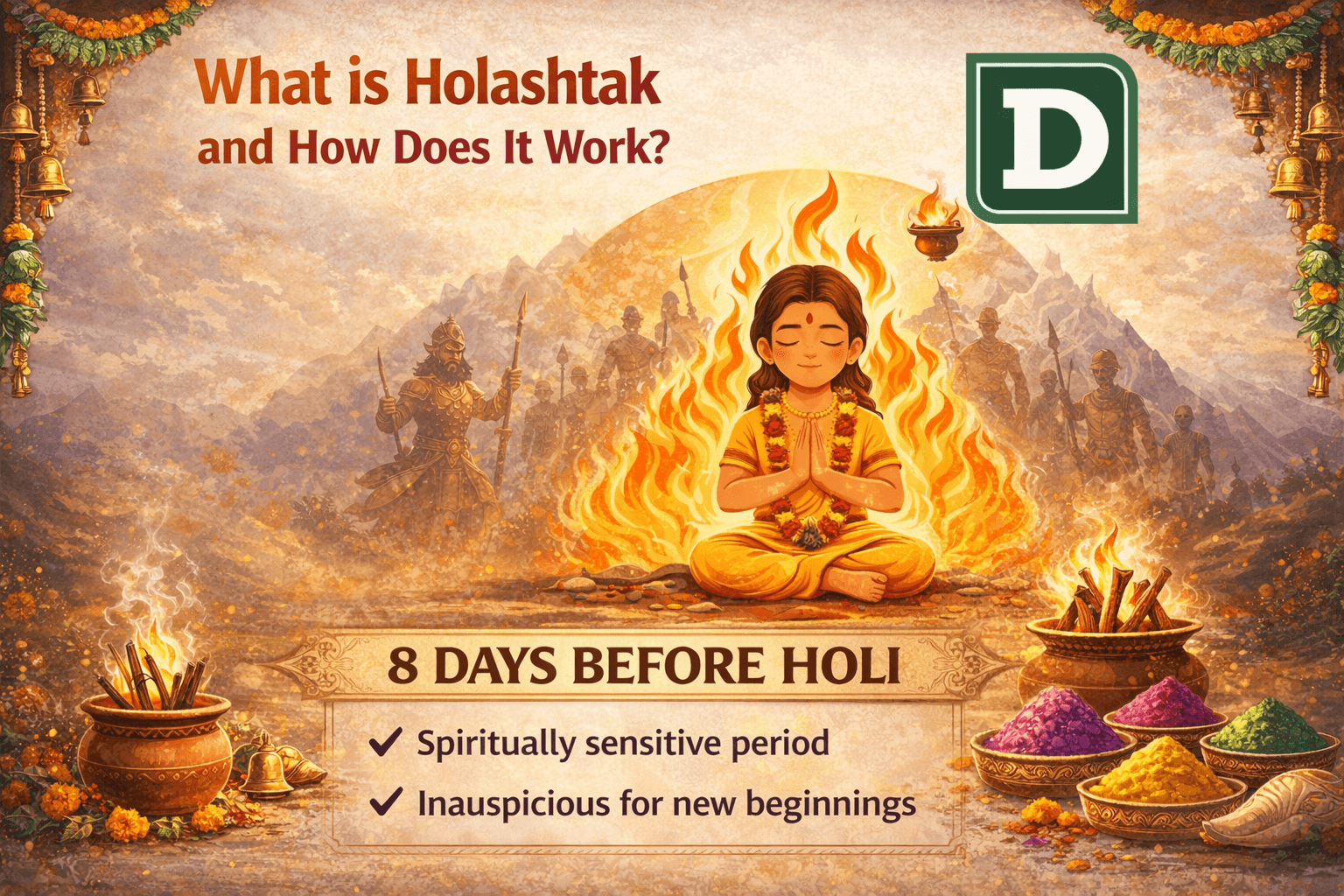
Holashtak is an eight-day, spiritually sensitive phase in the Hindu calendar that occurs immediately before the Holi festival. In the Hindu calendar, the Holashtak phase refers to the eight-day period immediately preceding the festival of Holi.
The festival of Holi is eagerly awaited across India, but before the vibrant colors fill the air, there is an eight-day period of caution known as holashtak.
If you have ever wondered, “What is Holashtak and how does it work?”, you are not alone. Many people search for the exact meaning of holashtak every year to understand its cultural and astrological importance.
Derived from the Sanskrit words Holi and Ashtak (meaning eight), this phase begins on the Ashtami Tithi (8th lunar day) of the Shukla Paksha (waxing moon) in the month of Phalguna and concludes on the Purnima (full moon day) with the ritual of Holika Dahan.
It is considered inauspicious for starting new or major life events, with the time focused instead on prayer, reflection, and, for many, the beginning of preparations for Holika Dahan.
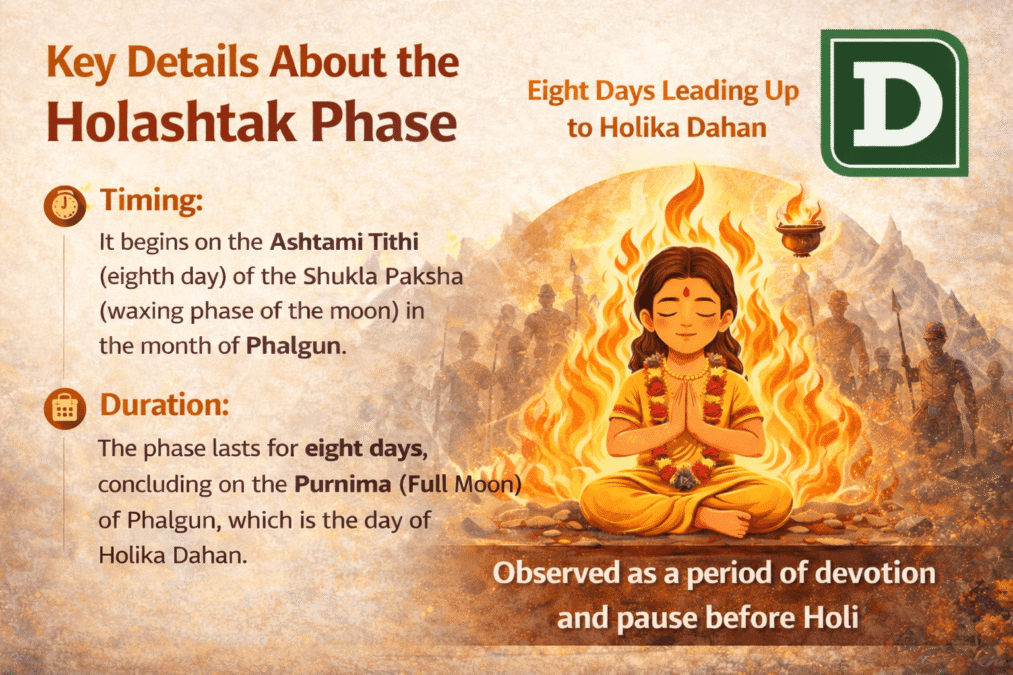
Key Details About the Holashtak Phase
For those asking “what is holashtak in hindi” or searching online for “holashtak kya hai” and “holashtak kya hota hai”, the answer is quite straightforward.
“Holi” combined with “Ashtak” (meaning eight) forms this word, representing the eight days leading up to Holika Dahan.
To answer “holashtak kyu manaya jata hai”, it is observed as a period of devotion and pause, commemorating the trials faced by the devotee Prahlad before his ultimate salvation by Lord Vishnu.
The true holashtak meaning is rooted in this spiritual reflection prior to the joyful celebrations of spring.
- Timing: It begins on the Ashtami Tithi (eighth day) of the Shukla Paksha (waxing phase of the moon) in the month of Phalgun.
- Duration: The phase lasts for eight days, concluding on the Purnima (Full Moon) of Phalgun, which is the day of Holika Dahan.
- “holashtak kab hai?” – It falls between February 24 and March 3, 2026.
- “holashtak kab lag raha hai?” and “holashtak kab lagega?” – It formally begins on the Ashtami tithi of the Shukla Paksha in the Phalgun month.
- “holashtak kab lagta hai?” – It always occurs exactly eight days before the main Holi festival.
- “holashtak kab se hai?” – From the morning of February 24th.
- “holashtak kab se kab tak hai?” – It spans from February 24 to March 3, 2026.
- “holashtak kab se lag raha hai?”, “holashtak kab se lagega?”, and “holashtak kab se shuru hai?” – All these popular queries point to the same start date of February 24, 2026.
- For those in Gujarat asking “holashtak kyare bese“, the period starts early on the morning of February 24.
This specific holashtak period directly corresponds to the holashtak tithi spanning from Phalgun Shukla Ashtami to Purnima.
Spiritual and Astrological Importance of Holashtak
It is considered Inauspicious for New Beginnings.
It is traditionally believed that during these eight days, the planetary energies are unsettled or “ugra” (aggressive), making it unsuitable for auspicious ceremonies like weddings, engagements (Vagdaan), housewarmings (Griha Pravesh), and starting new businesses.
Traditionally, these eight days are considered “inauspicious” for starting new ventures or major life events.
According to Vedic astrology, certain planetary energies are believed to be “unsettled” or “aggressive” during this time, which could negatively impact long-term commitments.
According to astrology and ancient scriptures, the planetary alignments during these days undergo changes that bring a sense of instability.
This naturally leads to the question of why holashtak is inauspicious. It is widely believed that negative energies are heightened during this transition, and starting anything new can face unexpected obstacles.
Mythological Beliefs
The Trial of Prahlad
The demon king Hiranyakashipu demanded worship from everyone in his kingdom. His young son Prahlad refused this order and worshipped Lord Vishnu instead.
Hiranyakashipu became furious at the defiance of his son. He began punishing Prahlad on the Ashtami tithi of the Phalguna month.
The king ordered soldiers to lock the boy in a room with poisonous snakes. The guards also threw Prahlad off a steep mountain cliff. Prahlad survived every attempt on his life through divine protection.
This physical and mental torture lasted for exactly eight days. The torment ended on the full moon day when Holika tried to burn Prahlad in a fire.
These eight days of suffering mark the inauspicious period of Holashtak.
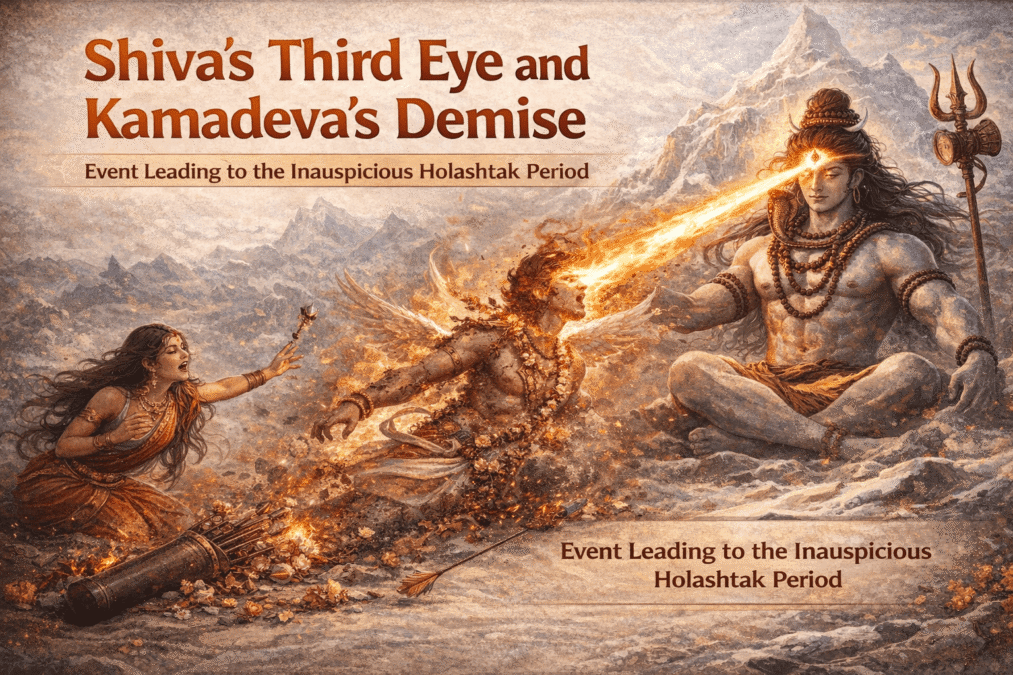
Shiva’s third eye and Kamadeva’s Demise
Hindu scriptures record Lord Shiva entering strict meditation after the death of Sati.
The demon Tarakasura attacked the gods during this period. The gods needed Shiva to marry Parvati to father a child capable of defeating the demon.
They sent the love god Kamadeva to break the focus of Shiva.
Kamadeva reached Mount Kailash on the Ashtami day of the Phalguna month. He shot an arrow made of flowers at Shiva. The arrow struck Shiva and broke his concentration.
Shiva opened his third eye in anger. Fire from the third eye burned Kamadeva to ashes.
The eight days of grief following this event formed the inauspicious period of Holashtak.
What activities are considered inauspicious during Holashtak?
Families often pause significant ceremonies like marriages, engagements, housewarmings (Griha Pravesh), and the purchase of property or vehicles.
During these eight days, certain actions are restricted.
To cover the basic guidelines on holashtak what not to do, it is strictly advised to postpone major life events. The list of holashtak mein varjit karya includes avoiding weddings, engagement ceremonies, mundan, and griha pravesh (housewarming).
If you are confused about holashtak mein kya kare kya na karen, here is a simple breakdown.
- “holashtak me kya nahi kharidna chahiye?” – You should avoid buying a new home, property, or vehicles.
- “holashtak me kya nahi karna chahiye?” and “holashtak me kya na kare?” – Do not launch new business ventures, sign major contracts, or make massive financial investments.
- “holashtak me kya nahi karna chahiye?” and “holashtak me kya na kare?” – Do not launch new business ventures, sign major contracts, or make massive financial investments.
Are there specific spiritual practices recommended for Holashtak observance?
On the other hand, “holashtak me kya karna chahiye?” the focus should turn entirely inward toward spirituality. Despite being inauspicious for material starts, it is highly valued for spiritual growth. Devotees focus on prayer, chanting mantras, meditation, and acts of charity (Dhaan).
2026 Timeline
According to the Hindu Panchang, the dates for Holashtak 2026 are:
- Starts: Tuesday, 24 February 2026.
- Ends: Tuesday, 3 March 2026 (culminating in Holika Dahan).
- Rangwali Holi: Wednesday, 4 March 2026.
wish you all the best
Всем, решил поговорить про подбор экономичных рейсов. Я путешествую регулярно — как правило по Европе и Ближнему Востоку, иногда в Дубай или в мини-отпуск. Прежде сидел на куче агрегаторов, но потом наткнулся на дешевые билеты из дубая — и убедился что тут гораздо эффективнее обычных агрегаторов.
Основной плюс — сравнивает дешевые авиакомпании, которых крупные платформы часто не находят. Вот, весной поймал авиабилет из Праги в Барселону за очень дешево — не думал что так бывает. Стоит обратить внимание!
Mass comment blasting: $10 for 100k comments. All from unique blog domains, zero duplicates. I will provide a full report and guarantee Ahrefs picks them up. Email mailto:helloboy1979@gmail.com for payment info.If you received this, you know Ive got the skills.