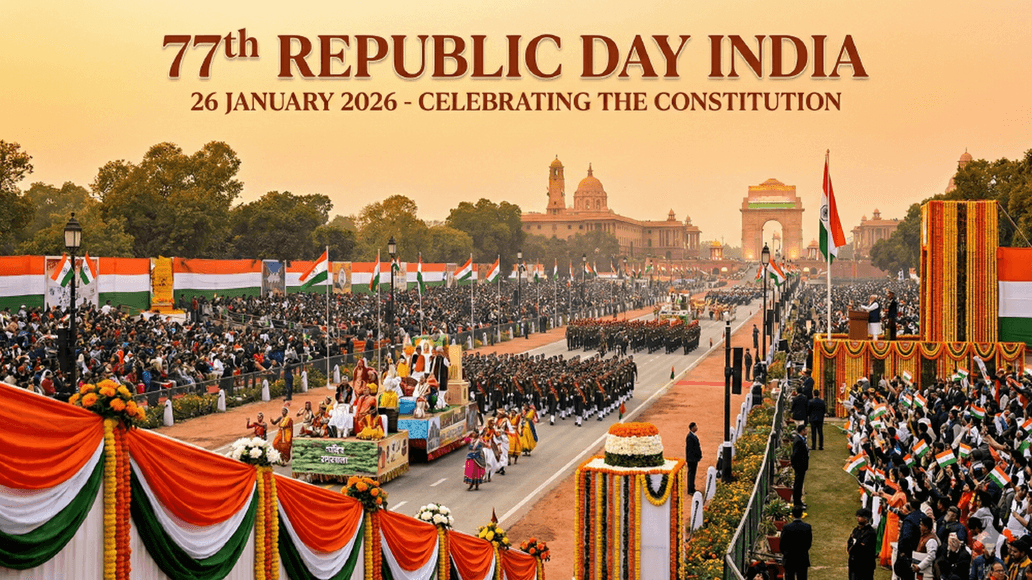
As the winter mist settles over Kartavya Path and the tricolour prepares to unfurl, the nation gears up for a historic celebration.
On 26 January of every year, India celebrates its Republic Day.
It is a moment not just for ceremony, but to reflect on the journey of the world’s largest democracy.
Whether you are looking for happy Republic Day wishes, curious about the difference between 15 August and 26 January, or searching for Republic Day parade tickets online booking 2026, this guide answers every question you have about this momentous day.
Why is Republic Day Celebrated in India?
While Independence Day (August 15) marks our freedom from British rule, Republic Day celebrates the soul of that freedom: The Constitution.
On 26 January 1950, the Constitution of India came into effect, replacing the Government of India Act (1935).
This legal transition turned India from a British Dominion into a sovereign, socialist, secular, and democratic republic.
This is why 26 January is important to us, as a Indian citizen.
The Constitution was adopted by the Constituent Assembly on November 26, 1949. This day is celebrated as Constitution Day in India.
However, the leaders chose to wait two months to legally enact it.
The leaders at that time wanted the date to coincide with January 26, 1930, the day When our Freedom Fighters at the Indian National Congress proclaimed Purna Swaraj (Total Independence).
That is why 26 January was chosen to honour that historic pledge, while 15 August is celebrated as our Independence day.
We should also remember one important thing that is India became a Republic on January 26, 1950, while in 1952 the first General Elections were held in independent Republic of India.
The Architects of the Republic
While Dr. B.R. Ambedkar is the father of the Constitution, we must also remember those who secured the territory that the Constitution governs.
Republic Day celebrates the principles that guide the nation. Who led the effort to unite princely states into modern India?
That legend is Sardar Vallabhbhai Patel. Without his iron will in integrating over 500 princely states, the map of the “Republic of India” we salute today would look very different.
If you want to get fit and strong by optimising your diet, check our essential vitamin guide here.
Republic Day vs. Independence Day: What is the Difference?
Many people ask, “What is the difference between 15 August Independence Day and 26 January?”
While both ceremony ignite patriotism, the protocols are distinct.
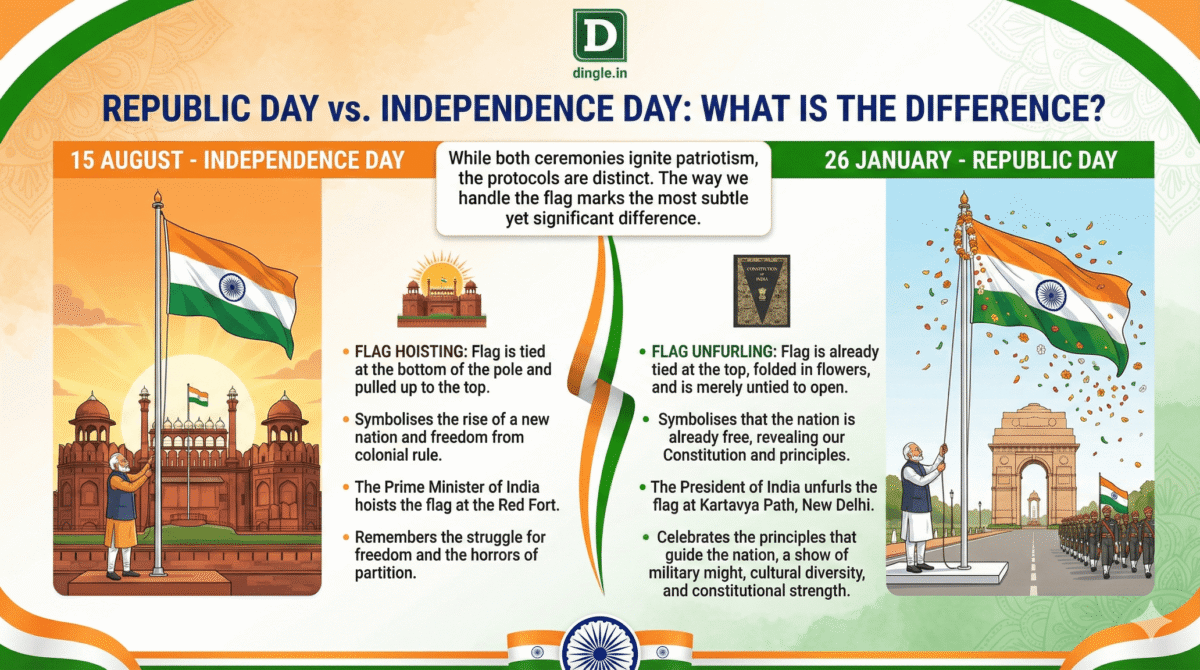
The way we handle the flag marks the most subtle yet significant difference. In terms we can say that on 15th August there is Flag Hoisting ceremony. While on 26th January, the President of India unfurls our flag, the Tiranga (तिरंगा) or tricolour.
15 August (Independence Day): Flag Hoisting
On 15 August (Independence Day) the flag is tied at the bottom of the pole and pulled up (hoisted) to the top.
This symbolises the rise of a new nation and freedom from colonial rule. The Independence Day remembers the struggle for freedom and the horrors of partition.
The Prime Minister of India hoists the flag at the Red Fort.
26 January (Republic Day): Flag Unfurling
On 26 January (Republic Day) the flag is already tied at the top of the pole, folded in flowers.
It is merely untied to let it open (unfurl).
This symbolises that the nation is already free, and we are now revealing our Constitution and renewed principles. The Republic Day celebrates the principles that guide the nation. It is a show of military might, cultural diversity, and constitutional strength.
The President of India unfurls the flag at Kartavya Path at New Delhi, the capital city of Indian Republic. The President views the parade from the Saluting Dais, located centrally on Kartavya Path, facing the National War Memorial and flanked by the rashtrapati bhavan gates.
Republic Day celebrates the principles that guide the nation. It is a show of military might, cultural diversity, and constitutional strength.
2026 Republic Day: The 77th Celebration
As we approach 26 January, excitement is peaking for the Republic Day.
The Republic Day Parade is the highlight of the day. It marches along Kartavya Path (formerly Rajpath), showcasing India’s defence capability and cultural heritage.
The tradition of hosting a foreign leader continues.
While the Chief Guest of Republic Day 2025 was Indonesian President Prabowo Subianto, the 2026 Republic Day hosts leaders from the European Union: Ursula von der Leyen (President of the European Commission) and António Costa (President of the European Council). Their presence highlights India’s growing global diplomatic ties.
How to Celebrate Republic day: Wishes, Quotes, and More
On this 26 January Happy Republic Day, share the spirit of patriotism with your friends and family. Here are some ideas for your status and messages:
Happy Republic Day Wishes
- “Freedom in mind, faith in words, pride in our heart, memories in our souls. Let’s salute the nation on Republic Day 2026!”
- “Wishing you a Happy Republic Day 26 January! May the tricolour always fly high.”
- “Happy Republic Day wishes to you and your family as we celebrate our 77th year of democracy.”
Activities for Students and Kids
- Republic Day Drawing: Encourage children to draw the Indian Republic Day parade or the tricolour to understand the day’s meaning.
- Speech on Republic Day: A great topic for school assemblies is “The journey from 1947 to 2026.”
Republic Day Song: Listening to ‘Vande Mataram’ or ‘Sare Jahan Se Achha’ rekindles the patriotic fire.
Conclusion
As we mark the 26 January 2026 Republic Day, we are not just looking back at 1950; we are looking forward.
From the first Republic Day to the 77th Republic Day 2026, India has grown into a global powerhouse.
Since gaining independence in 1947, India has transformed from a newly birthed nation into the world’s largest democracy and forth-largest economy, showcasing remarkable resilience and growth.
The country achieved self-sufficiency in food production through the Green Revolution and has subsequently established itself as a global leader in information technology and pharmaceuticals.
Scientifically, India has made history with cost-effective space missions like Chandrayaan-3 and Mangalyaan, proving its technological prowess on the global stage.
Domestically, the digital revolution has connected over a billion citizens through the Unified Payments Interface (UPI) and Aadhaar, while massive infrastructure projects have modernised the nation’s connectivity.
Today, India stands as a nuclear power and a decisive geopolitical voice, embodying the spirit of a vibrant, diverse, and progressive republic.
Whether you are watching the Republic Day parade on TV, hunting for a Republic Day sale 2026, or simply sharing Republic Day images on WhatsApp, remember the core message: We are a nation of the people, by the people, for the people.
Jai Hind!
Vande Mataram!
Bharat Mata ki Jai!
Happy Republic Day!
Салют,
Коллеги.
В данный момент я бы хотел оповестить малость
про купить ссылки для сайта на яндекс.
Если вы всё ещё верите, что можно расти без ссылочного профиля — вы добровольно отдаёте трафик конкурентам.
куплю постоянные ссылки
Под новые фильтры и сигналы ранжирования 2026 в топ выходят
сайты с сильным ссылочным профилем.
куплю ссылки на ваших сайтах
Если вы хотите доминировать в выдаче, вам
нужны **рабочие SEO ссылки**, а не
токсичные PBN. где купить
хорошую ссылку
Мы предлагаем живые ссылки, которые дают рост.
Это не просто покупка ссылок — это оружие.
купить вечную ссылку на сайте
Почему? наши ссылки работают даже после апдейта 2026:
– Площадки, которые проходят все фильтры
– Трастовые домены, которые
усиливают ваш ссылочный профиль
– Анкоры под новые требования поисковиков
– Никакой автоматизации
– Никаких PBN
Вы получаете **ссылки, которые реально работают**,
а не имитацию линкбилдинга. купить ссылку в
статье
+ Забудьте про количество — важна сила
Один сильный донор даёт больше, чем 50 слабых.
Поисковики видят качество, поэтому мы даём **естественные, тематические, трастовые ссылки**, которые дают рост даже после апдейта 2026.
купить текстовые ссылки
* Стратегический линкбилдинг — это необходимость
Если вы хотите:
– вырваться вперёд
– расти без рекламы
– поднять ключевые запросы
– повысить авторитет домена
— вам нужны **ссылки, которые дают результат**, а не имитация работы.
купил ссылки на сайт когда заработают
Мы создаём разнообразный ссылочный профиль, который работает под
новые алгоритмы 2026. купить ссылки с сми
Хотите доминировать? Тогда действуйте
Мы не продаём “ссылки ради ссылок”.
Мы продаём **результат**, и если вам нужен рост
— мы его обеспечим. ссылки в профилях форум купить
На нашем сайте больше про купить
ссылку тиц – Наш сайт — https://tumblr.com/seoquantum или про куплю ссылки в контакте
Наши Теги: купить крауд ссылки, как купить
ссылки у конкурентов, где дешево купить
вечные ссылки, купить трастовые ссылки,
купить аккаунт кс го с инвентарем ссылка.
Доброго Вам Дня! https://tumblr.com/seoquantum